
As a profession, we are acutely aware of the prevalence of ‘burnout’. A 2021 report from the AVMA showed that 40% of veterinarians are considering leaving the profession, and the most frequently cited reason for this is a lack of work-life balance.
As an aside, I actually think “work-life balance” is an overused and inaccurate phrase. What is more universally problematic is a lack of work accomplishment, or sense of completeness.
I work with many people, myself included, whose choice of leisure activity would often be what others might consider “still work.” Reading journal articles, taking a day off to volunteer one’s services at a rescue centre or local zoo, attending a conference, or writing an article such as this one. One’s ability to do these things is hampered if you feel you simply cannot step out of the busy work environment, or that even when you do, there’s a huge backlog of work you are not choosing to have occupying your headspace.
Equally, being able to engage in creative, completely autonomous work or professional development that you freely choose for yourself still constitutes “switching off” for some, just as much as sitting by the pool or doing the gardening might constitute relaxation for someone else.
For this reason, simply making sure people go home on time is no way to guarantee that they will not still suffer from burnout. Free time is a mental state, not only a physical one. You can be off the clock but still, mentally, at work.
The thing which universally prevents people from being able to enjoy time which is truly free from imposition is the ability to complete work. To reach a conclusion or endpoint, so that you can walk out of your workplace, or close down your emails, and feel done. It is the never-ending treadmill that turns your chosen profession into a real life enactment of that nightmare that almost everyone experiences; that one where you’re running, but never moving fast enough.
Artificial intelligence in echocardiography can really go one of two ways.
Most companies, particularly in the human space, focus on the time-saving argument: automate measurements, and now an echocardiogram can be reported 75% faster. To echocardiographers, though, arguments about “enhanced productivity” is just code for “cram more patients into the same amount of time”; hardly a recipe for reducing overwhelm.
In both human and veterinary medicine, demand for echocardiography far outstrips supply. Even if AI assistance meant we could see twice the current number of patients per day, the goalposts would simply move to accommodate our increased capacity. We would never catch up. Greater availability would encourage more referrals. After all, echocardiography is indisputably the most valuable diagnostic test for suspected heart disease, and one could make an argument for almost any patient to have one, particularly pre-anaesthesia.
A better reason to adopt AI-assisted echocardiography measurements and reporting is not so that veterinarians can spend less time reporting their scans, but that they can reinvest that saved time in the more enjoyable and valuable aspects of an echocardiogram. Instead of agonising over a left atrial diameter measurement for 10 minutes (“if I measure here it’s normal, but if I measure here’s it’s dilated…”), the vet can focus on making the diagnosis – most likely a much more in-depth, prognostically informative one than they would previously have had time to make. You can look beyond the now and project into the future – instead of just “the left atrium is dilated,” you now have time to look at other measurements obtained from your images and how they might relate to your patient’s future risk of heart failure.
Having that precious extra time to be able to do a thorough, complete job, brings great professional satisfaction. The feeling of a job well done, where you have invested time in yourself and delivered an evidenced diagnosis for your patient, is highly fulfilling. Another report rushed off before your next patient arrives or before you fall asleep at your desk definitely is not.
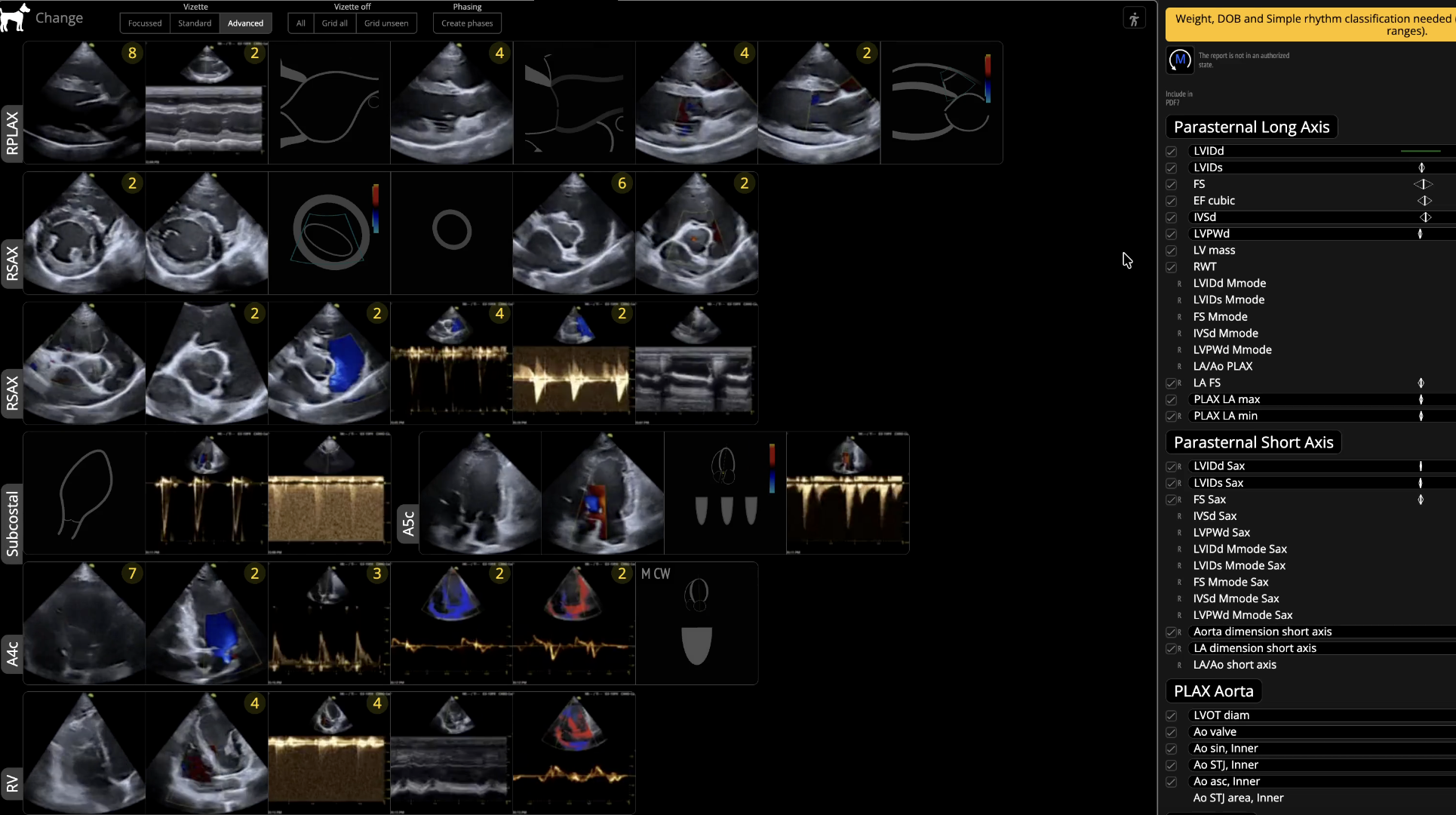
AI should be incorporated into veterinary medicine with caution, and if adopted for the wrong reasons, it could definitely make things worse. Quantum has been developed by veterinary echocardiographers, for veterinary echocardiographers. There are strong financial arguments for adopting Quantum – more standardised, professional reports, which enable clinics to bill appropriately and attract more referrals – but, crucially, there are equally strong professional ones, centred around alleviating stress, providing better expert support, and fostering professional development.
Any decision to incorporate artificial intelligence into echo reporting should be made jointly by the financial decision-maker and the veterinarians actually using this technology in their work.
Will Quantum enable veterinarians with already full echo lists to pump out 3x as many echocardiograms per day than before? No. If that is what you are looking for, there are fully automated solutions out there, although the 2026 BSE position statement places these technologies as still in the research phase and not yet safe for clinical deployment. The biggest problems with this are, first of all, the quality of the reporting when no peer-reviewed validation studies exist for it, and secondly, the ability of the veterinarian using it to critically assess it. If you are a novice user of echocardiography, having an AI bot write you an advanced-level echo report is not something you are going to have the experience to be able to judge for accuracy.
Nevertheless, these solutions now exist, and companies are happy to charge you for them.
Quantum Veterinary Echocardiography does not write the echo report for you. It provides you the evidence and the measurements, but the final report is still performed by the veterinarian. Instead, with the extra information at your fingertips and exponentially less time spent obtaining it, you can rediscover your love of cardiology, push your learning and skills to new levels, and enjoy the process.
References
Bain, B. et al. (2021). AVMA Report on Economic State of the Veterinary Profession. Schaumburg, IL: American Veterinary Medical Association.
Bennett, S., Wild, C., Paton, M.F. et al. Artificial intelligence in echocardiography: a position statement from the British Society of Echocardiography. Echo Res Pract 13, 26 (2026). https://doi.org/10.1186/s44156-026-00124-4
Neill CL, Hansen CR and Salois M (2022) The Economic Cost of Burnout in Veterinary Medicine. Front. Vet. Sci. 9:814104. doi: 10.3389/fvets.2022.814104
© 2026 | AUA – All Rights Reserved
